
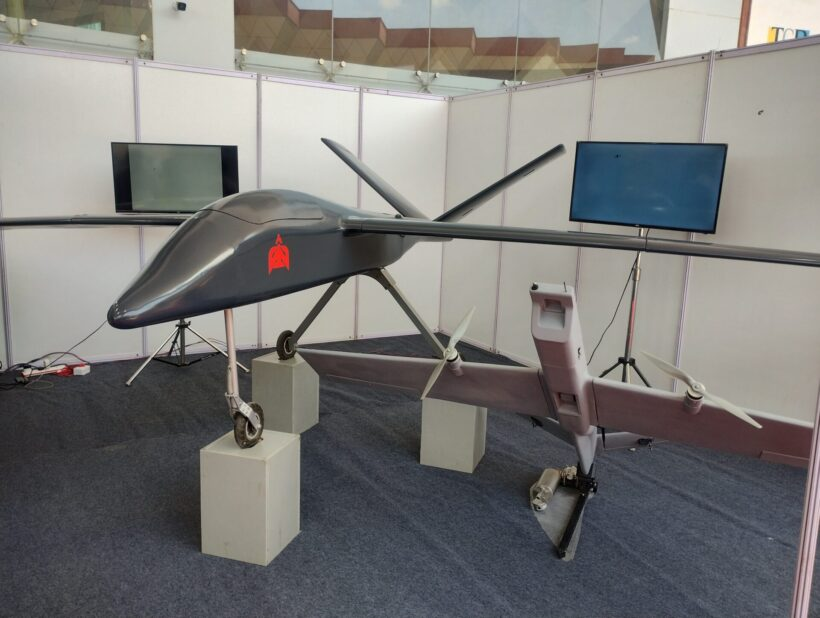
Quando l’IA prende il controllo dei sistemi d’arma
(Immagine di Gpkp / wikimedia)
L’intelligenza artificiale sta rapidamente entrando nella difesa nazionale. Ricognizione, allarme precoce, rilevamento bersagli, pianificazione della missione—ovunque, i sistemi di apprendimento automatico promettono analisi più rapide, risposte più rapide e decisioni più rapide.
In un contesto militare, questo sembra un progresso. In realtà, l’IA aggrava un problema di sicurezza che tecnicamente non può essere risolto. Chiunque ci provi comunque rischia di ottenere l’opposto di ciò a cui aspira.
Di Karl Hans Bläsius, Axel Fersen e Klaus Moegling
Sviluppi attuali
Il presidente degli Stati Uniti Donald Trump non vede alcun problema nell’avanzamento incontrollato dell’IA. Sostiene che l’alto QI di un presidente sia l’unica “barriera” di cui l’IA ha bisogno, quindi gli americani non hanno nulla di cui preoccuparsi.
Mantiene questa affermazione anche di fronte alle preoccupazioni sollevate dai principali sviluppatori di IA statunitensi riguardo a ulteriori sviluppi di IA incontrollati. Secondo Trump, anche il presidente cinese Xi non vede alcun problema che possa ostacolare il rapido progresso dell’IA. Allo stesso tempo, stanno emergendo sempre più incidenti in cui agenti IA agiscono in modo indipendente e attaccano altri sistemi. Questo è accaduto non solo negli Stati Uniti, ma anche in Cina. Inoltre, è emerso l’attacco autonomo di un agente AI della società statunitense OpenAI su un portale governativo australiano, così come altri incidenti negli Stati Uniti in cui sciami di agenti IA hanno tentato di ottenere accesso non autorizzato ad aree sicure.
Abbiamo già superato il punto in cui gli esseri umani mantengono ancora il controllo sull’IA che hanno sviluppato? Quanto siamo lontani dallo sviluppo di una superintelligenza che si ottimizza autonomamente, sviluppa capacità sovrume attraverso vari spettri di performance e—senza essere istruita—si rivolta contro l’umanità?
Il CEO di Anthropic Dario Amodei sta ora avvertendo il Consiglio di Sicurezza dell’ONU sui rischi di uno sviluppo continuo e non regolamentato dell’IA:
“Se gestita male, credo persino che quell’IA potrebbe rappresentare un rischio per tutta l’umanità.”
Alla luce dei pericoli attuali, altri sviluppatori di IA e CEO di aziende leader dell’IA hanno chiesto al Consiglio di Sicurezza la cooperazione internazionale e la supervisione politica dello sviluppo dell’IA. Tra questi c’erano il CEO di OpenAI Sam Altman, il cofondatore di Hugging Face Clement Delangue e lo sviluppatore canadese di IA Yoshua Bengio.
Trump, invece, aveva precedentemente liquidato le critiche allo sviluppo incontrollato dell’IA come una “bufala” e una “cospirazione malata”—come ha dichiarato Trump su Truth Social:
“L’idea che l’IA possa conquistare il mondo, distruggere l’umanità e fare tutte quelle altre cose terribili è una bufala.”
Sebbene non sembri esserci alcun problema a richiedere regolamentazione, Trump e Xi hanno concordato durante la recente visita di Stato di Xi negli Stati Uniti di istituire un canale di comunicazione e un dialogo sullo sviluppo dell’IA. Qui, il livello di prudenza di Xi su questo tema sembra evidente.
In un successivo incontro alla Casa Bianca a cui hanno partecipato, tra gli altri, Alex Karp (Palantir), Elon Musk (SpaceX), Mark Zuckerberg (Meta), Dario Amodei (Anthropic) e Jeff Bezos (Amazon), Trump ha dichiarato di rimanere contrario alla regolamentazione governativa o internazionale, poiché l’autoregolamentazione da parte delle aziende era sufficiente. Di conseguenza, le aziende di IA firmarono un impegno volontario; tuttavia, era non vincolante e basata sulla partecipazione volontaria, senza, ad esempio, la creazione di un organo di supervisione. Trump dopo l’incontro:
“Tutto questo porterà a cose buone, e ci assicureremo che tutto funzioni senza intoppi e in sicurezza.”
È stata esattamente la situazione opposta a spingere i dirigenti tecnologici a rivolgere il loro avvertimento al governo degli Stati Uniti e alle Nazioni Unite.
Tuttavia, va notato che gli episodi finora hanno coinvolto l’infiltrazione di IA in strutture civili. Ma cosa succede se agenti IA infiltrano sistemi d’arma, o se l’IA implementata nei sistemi d’arma prende vita propria?
What Military AI Actually Does
Traditional software follows rules that a human has written beforehand: If A, then B. Anyone who understands such a program can trace, step by step, how it arrives at its result. Modern AI works differently. It isn’t programmed, but rather trained. It is fed vast amounts of examples—images, texts, sensor data—and the system derives patterns from them on its own. In the end, no one knows exactly how it weights these patterns in detail, not even the developers.
We’ve long encountered such systems in our everyday civilian lives. The spam filter decides, based on statistical similarity, whether an email lands in the inbox or the junk folder. Facial recognition on a smartphone compares pixel patterns with stored patterns. The traffic forecast on a navigation device draws conclusions about the next twenty minutes based on millions of trips. Such applications are useful because a misjudgment usually has no consequences. An email that was mistakenly filtered out can be searched for and found. If a face isn’t recognized by a cell phone, the user can simply enter the PIN code.
In national defense, the stakes are much higher. Here, systems aren’t meant to distinguish between advertisements and invoices, but rather to assess—based on satellite images, radio signals, and drone footage—whether movement on the ground poses a threat—and they do so under enormous time pressure. Anyone who uses a spam filter tacitly accepts a margin of error. Anyone who deploys a military AI system does the same—only the consequences of a misjudgment are different. It is this shift in scale that turns what appears to be a technical question into a political one.
When Probability Looks Like Certainty
The logic of the time advantage is an old one. The so-called decision cycle—observe, assess, decide, act—is supposed to become shorter. But acceleration has an unpleasant characteristic: it does not automatically improve the quality of a decision. Sometimes it simply speeds up error. AI does not operate in a clean-cut world. It makes decisions under conditions of incompleteness, vagueness, and uncertainty. Sensors provide unclear signals, data is missing, and adversaries camouflage and deceive. Electronic warfare further alters the information landscape. What appears precise remains fallible.
A simple example illustrates this clearly. Anyone seeking to distinguish combatants from civilians looks for distinguishing features. Wearing a helmet is considered one of them. But the uncertainty doubles: Even determining whether someone is actually wearing a helmet is a statistical matter and not definitive. A certain hairstyle or a shadow can lead to the detection of a helmet even though none is present; conversely, an unfavorable reflection of light can prevent the detection of a helmet. And the inference from a helmet to a combatant is, of course, merely probable, since a soldier might have briefly taken off his helmet, and a civilian—such as a construction worker—might be wearing one. No certain conclusions can be drawn from uncertain information, no matter how large the model becomes. Even the best system merely shifts uncertainty into more elegant weightings—and ultimately delivers probabilities that look like certainties.
Those who do not deal with statistics on a daily basis easily underestimate what is happening here. Even a system with a high hit rate produces errors on a scale that inevitably grows with the amount of data analyzed. When intelligence agencies process hundreds of thousands of images per day, even a small percentage of incorrect assessments results in a considerable absolute number of misjudgments. Added to this is an effect well known in statistics: the rarer the case being sought occurs in the population, the more severely the proportion of false alarms affects innocent bystanders. Especially in conflict zones, where civilians make up the majority, this is not a theoretical problem but one of great moral and political significance. In military applications, however, such a system is often touted as progress because it operates faster than any human analysis. Speed, however, does not produce truth; it merely multiplies the number of decisions, whether right or wrong.
Added to this is the lack of verifiability. Modern systems rely on countless features simultaneously. Their internal reasoning is rarely traceable in a form that truly enables human oversight in an emergency. With generative AI, the problem is particularly evident: it provides answers but no verifiable rationale. In security-related contexts, this is not a minor issue but a red line. Anyone who wants to deploy systems where decisions about life and death are made should be able to explain very precisely why technical sophistication should be considered a basis for judgment in this context.
The Invisible Armament
But the problems extend beyond individual decisions. AI is changing the very architecture of security policy. In traditional arms control, the balance of power was roughly measurable: tanks, aircraft, soldiers, delivery systems, ranges. Much of it was visible, countable, and at least partially verifiable through agreements. The Open Skies Treaty, signed in 1992, allowed for mutual observation flights between NATO countries and former Soviet republics—until the U.S. withdrew in 2020. The 1987 INF Treaty banned land-based medium-range missiles for more than three decades. Such treaties were laborious. But they worked.
With AI and cyberweapons, this principle no longer applies. Capabilities can be developed in secret. Software can be copied, adapted, and distributed in countless variations. Once something has been developed, it never disappears. Even if one wanted to conclude agreements, there would be no quantifiable units to limit. One’s own capabilities, too, can only be tested to a limited extent. In reality, cyberweapons can hardly be tested without risking collateral damage. The joint U.S.-Israeli Stuxnet attack on an Iranian uranium enrichment facility in 2010 accidentally infected more than 50,000 computers in India, Indonesia, Pakistan, and other countries. If neither side knows what it is capable of—let alone what the other is capable of—stability becomes a matter of chance.
Humans Are Too Slow for Their Own Weapons
This exacerbates a risk that has long been recognized within the military itself. The requirement that a human must remain “in the loop” sounds reassuring. But what does this “loop” actually mean? It means that while a machine may generate a proposal, a human must review and approve it before any action is taken. In practice, the available time windows vary greatly—ranging from hours in strategic situation assessment to a few seconds in tactical air defense. The shorter the window, the less room there is for an independent evaluation of the data on which the system based its recommendation. The notion that a truly independent review always takes place does not consistently hold up in reality.
Added to this is a phenomenon described in human-machine research as “automation bias”: Those who have repeatedly observed a technical system to function reliably are more inclined to confirm rather than contradict it in an emergency. Furthermore, a tendency toward passive involvement over time leads to a loss of competence, which further narrows the scope for independent judgment. In the announcement for a conference hosted by the Joint Air Power Competence Center this year in Essen, this question was framed as a key point of discussion: How can service members “maintain meaningful control while the pace of operations approaches the speed of machines”? Anyone who poses this question in this way already senses how difficult it is to answer.
What Can No Longer Be Postponed
This is precisely where the real political challenge lies. Where technology becomes opaque, politics must become more transparent. Where armaments grow behind closed doors, the channels of communication between capitals must become more frequent. Where learning systems shorten response times, politics must remain slow enough to set limits. This is not an old-fashioned longing for détente. It is the sober response to a technological reality that cannot be reversed.
First: We need robust communication channels between the major military powers—including, and especially, with rivals. Direct links between defense ministries and military leadership, crisis hotlines, and regular consultations on false alarms and near-misses. Such mechanisms existed during the Cold War, and they prevented escalation. In the age of automated decision-making, they are once again indispensable. Those who do not speak with their adversaries let AI do the talking—and that is a poor trade-off.
Second: We need arms control that addresses this new reality. Traditional treaties counted unit numbers. New frameworks must account for software behavior, training data, rules of engagement, and autonomous functions—as well as the thresholds beyond which a system acts on its own. International voluntary commitments not to delegate the use of lethal force to machines are a first step. Binding bans on fully autonomous weapon systems—those permitted to kill without human authorization—would be the second. Such rules are difficult to verify. But they are better than agreeing to nothing.
Third: Europe has a responsibility here that it cannot delegate. The European AI Act regulates civilian applications. In terms of security policy, the work is only just beginning. The EU should not outsource the proposal for an international framework for military AI to Washington or Beijing. It can take the initiative itself—together with countries such as Switzerland, Brazil, Mexico, or South Korea, which, as impartial mediators, are more credible than the major powers that are direct rivals. A European initiative for military AI arms control would also serve as a counterargument to those who see Brussels as nothing more than a regulatory machine and fail to recognize European sovereignty as something in its own right.
Fourth, and most importantly: If you want effective rules, there’s no getting around negotiations. If you want to mitigate global risks, you must also talk to rivals. That sounds old-fashioned, but it isn’t. It’s simply realistic. Security does not arise from strength alone. It arises from understanding, transparency, and robust channels of communication between states and societies. Trust is not a “soft” word. It is the only resource that can still foster stability in a world of invisible capabilities.
The real challenge of AI in national defense is therefore not technical, but political in nature. The systems are getting faster. This does not make the world any clearer—quite the opposite. Precisely because machines accelerate military processes, policymakers must remain wise and persistent enough to decide what machines must not be allowed to decide. Anyone who believes that intelligent weapons can replace smart diplomacy has failed to understand that, in the age of AI, security is first and foremost a political task before it becomes a technical one.
It is to be hoped that Xi will prevail here over Trump, whose family—according to media reports—is said to have recently directed its investment activities toward shares in AI companies and data centers.
Perhaps this also presents an opportunity for cooperation between the EU and the People’s Republic of China to avert threatening developments, particularly with regard to the possible emergence of a superintelligence.
(This article was first published in: Common Dreams, Karl Hans Bläsius, Axel Fersen, Klaus Moegling When AI Takes Control of Weapons Systems. 7.10.26)
Karl Hans Bläsius, Prof. Dr., is a computer scientist and professor emeritus at Trier University of Applied Sciences. As an AI pioneer, he has worked in particular on knowledge-based systems, document analysis, and computer-aided early-warning and decision-making systems. He is the founder of atomkrieg-aus-versehen.de and ki-folgen.de and the author of the new book “Künstliche Intelligenz und Krieg” (Springer Nature 2026). Among other roles, he is a member of the scientific advisory board of the Erhard Eppler Circle.
Axel Fersen è uno scienziato politico ed esperto di trasformazione digitale e intelligenza artificiale. Dopo aver completato gli studi presso l’Università Johannes Gutenberg di Magonza, il suo percorso professionale lo ha portato nel settore tecnologico. Oggi vive e lavora a Barcellona. Coordina l’Erhard Eppler Circle, fa parte del suo comitato direttivo, è membro del consiglio dell’Istituto Europeo per la Ricerca Sociale e Sanitaria presso l’Alice Salomon University of Applied Sciences di Berlino ed è attivo nel gruppo di studio sulla valutazione tecnologica della digitalizzazione presso l’Associazione degli Scienziati Tedeschi (VDW).
https://www.erhard-eppler-kreis.de/uber-uns
Klaus Moegling, Prof. Dr. (in pensione), è uno scienziato politico, ricercatore per la pace e sociologo. Ha insegnato in varie università e istituti di formazione degli insegnanti, più recentemente all’Università di Kassel come professore nel Dipartimento di Scienze Sociali; tra gli altri ruoli, è membro del comitato consultivo scientifico dell’Erhard Eppler Circle.
È autore del libro “Realignment: Is a Peaceful and Sustainably Developed World Still Possible?”, la cui settima edizione aggiornata ed ampliata è disponibile gratuitamente sul suo sito web: https://www.klaus-moegling.de/international-edition/
Insieme a Josef Mühlbauer (Università di Graz), ha curato il volume “Paths to Peace: Perspectives on Critical Peace Research” (maggio 2026, Verlag Westfälisches Dampfboot), disponibile in formato cartaceo e in open access: https://www.dampfboot-verlag.de/de/buecher/wege-zum-frieden
10/10/2026 https://www.pressenza.com/




Lascia un Commento
Vuoi partecipare alla discussione?Sentitevi liberi di contribuire!